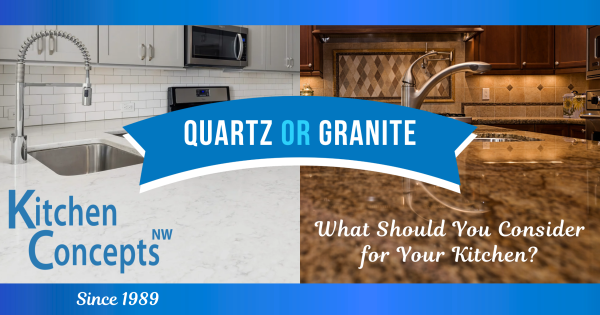
When planning a kitchen remodel, countertops are one of the decisions homeowners tend to spend a lot of time thinking about—and for good reason.
Countertops take up a significant amount of visual space, are used every day, and can represent an important part of the remodeling budget.
Two materials that often come up in the conversation are quartz and granite.
Both can be excellent choices. Both are durable. Both are available in a wide range of colors and styles. But they aren’t exactly the same, and the right choice isn’t simply a matter of deciding which one looks better in a showroom.
At Kitchen Concepts, we believe material selections should be considered as part of the entire kitchen. How do you use the space? How much maintenance are you comfortable with? What cabinets, flooring and backsplash will surround the countertop? And, of course, what look are you trying to achieve?
First, What’s the Difference Between Quartz and Granite?
Although they can sometimes look similar, quartz and granite countertops are made very differently.
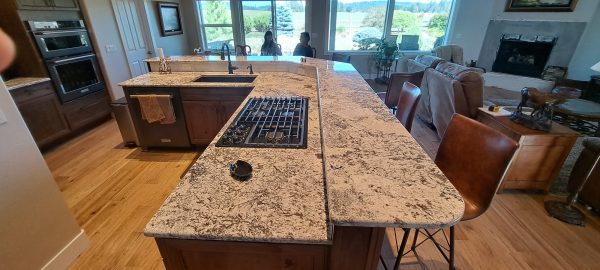
Granite is a natural stone. It is quarried from the earth, cut into slabs and fabricated for use as a countertop. Because it is a natural material, every slab has its own variations in color, pattern and movement.
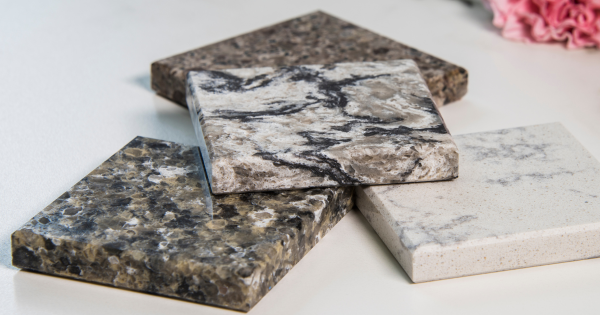
Quartz countertops are engineered surfaces. They are manufactured using quartz minerals combined with resins, pigments and other materials. This allows manufacturers to create a much broader and more controlled range of colors and patterns.
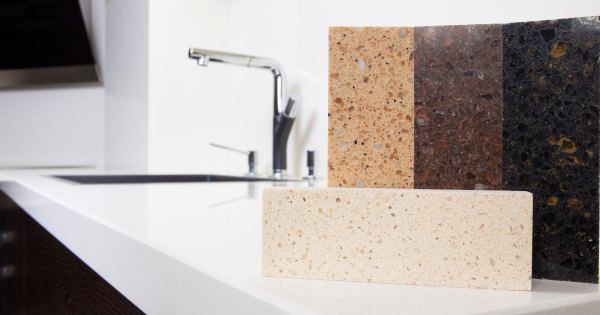
These fundamental differences affect several of the decisions
-
Appearance: Natural Variation or More Predictability?
For some homeowners, the individuality of natural stone is one of granite’s biggest attractions. Veining, mineral deposits and variations across the slab mean that no two pieces of granite are exactly alike. Depending on the stone you choose, those variations can be subtle or quite dramatic. Quartz generally offers more predictability.
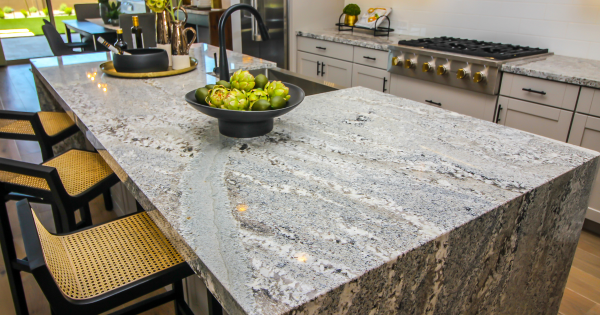
Manufacturers can create surfaces ranging from relatively uniform colors to patterns designed to resemble marble and other natural stones. If you are trying to coordinate countertops with cabinetry, tile and flooring, that consistency can sometimes make the selection process easier. Neither approach is inherently better.
The question is whether you prefer the natural variation and uniqueness of granite or the greater consistency and design control available with quartz.
-
Maintenance: How Much Upkeep Do You Want?
This is one of the practical differences homeowners should understand before making a selection. Because granite is a natural, porous stone, it generally requires sealing to help protect it against staining and moisture. How frequently that needs to be done can vary depending on the particular stone and sealer. Quartz is nonporous and does not require routine sealing. For homeowners who want a countertop that requires relatively little ongoing maintenance, that can be an advantage.
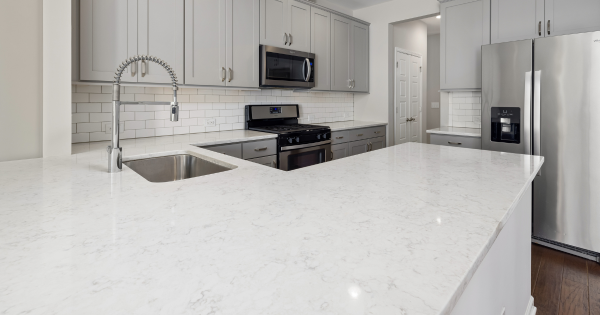
That doesn’t mean quartz is maintenance-free—or that granite is difficult to live with. Both still need normal cleaning and reasonable care. It simply means the maintenance requirements aren’t identical, and that is worth factoring into the decision.
-
Durability: Both Are Tough, but Not Indestructible
A kitchen countertop needs to withstand years of cooking, cleaning, entertaining and everyday family life. Both granite and quartz are durable countertop materials when properly installed and cared for. Granite has excellent heat resistance, although using trivets or heat protection is still a good habit with any countertop.
Quartz also performs very well in everyday kitchen use, but the resins used in manufacturing can be affected by excessive heat. Hot pans should not be placed directly on the surface.
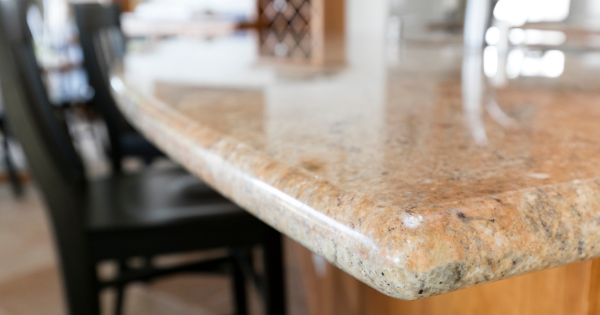
And despite their durability, neither countertop should be treated as indestructible. Edges can chip, heavy impacts can cause damage, and using cutting boards rather than cutting directly on the countertop is a good practice regardless of the material you select.
-
Think About the Entire Kitchen, Not Just the Countertop
This is where countertop selection becomes part of kitchen design rather than simply product selection. A countertop may look beautiful by itself but still not be the best choice once you put it next to your cabinets, flooring, backsplash and wall colors.
For example, cabinetry with prominent wood grain may pair beautifully with a quieter countertop. In another kitchen, simple painted cabinetry might provide an opportunity for more movement or pattern in the countertop.
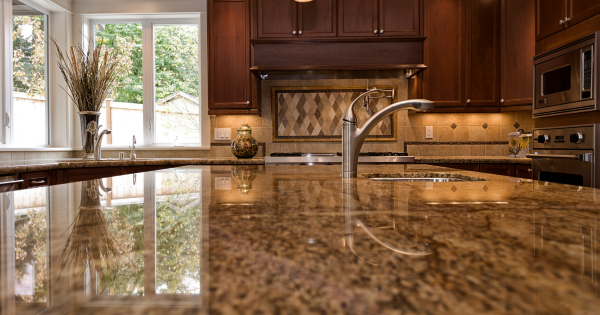
Lighting matters, too. Samples can look quite different under showroom lighting than they do inside your home. Natural light, under-cabinet lighting and surrounding colors can all affect how a countertop appears. That’s why we prefer to look at these selections together rather than individually.
-
Don’t Forget the Backsplash
Countertop and backsplash decisions are closely connected. If you choose a countertop with dramatic veining or considerable movement, a simpler backsplash may allow the countertop to become the focal point. With a quieter countertop, you may have more flexibility to introduce pattern, texture or color through tile.
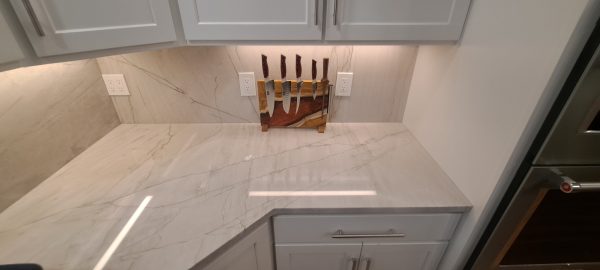
Another option is continuing the countertop material up the wall for a coordinated look, although that choice can affect the overall project budget. The important thing is to avoid treating the countertop and backsplash as two completely separate decisions. They share the same visual space and should work together.
-
What About Cost?
There isn’t a reliable rule that says granite is always less expensive than quartz—or vice versa. Pricing for both materials can vary considerably based on the specific product or stone selected, slab availability, thickness, edge treatment, fabrication, installation and the amount of material required.
Kitchen layout also matters. A large island, multiple seams, unusual shapes or additional fabrication can affect countertop costs regardless of which material you choose. That’s one reason we encourage homeowners to think about the overall remodeling budget rather than becoming too focused on the price of one individual material.
Sometimes spending more in one area makes sense. Sometimes it doesn’t. The goal is to decide where your remodeling dollars will make the biggest difference to the kitchen you want to create.
-
Which Is Better for Resale?
Homeowners sometimes ask whether quartz or granite will add more value to their home. Both are widely recognized as quality countertop materials, and either can be an attractive feature in a remodeled kitchen. Rather than choosing solely around what a future buyer might prefer, we generally recommend selecting a quality material that works with the overall design of the kitchen and the way you expect to use it.
A well-designed kitchen that feels cohesive, functions well and uses appropriate materials is usually a better goal than selecting one surface simply because it is currently more popular. So, Should You Choose Quartz or Granite? There isn’t one answer for every kitchen.
Quartz may be worth considering if you:
- Prefer more consistency in color and pattern
- Want a broad range of design options
- Prefer a nonporous surface that doesn’t require routine sealing
- Want relatively simple day-to-day maintenance
Granite may be worth considering if you:
- Love the variation found in natural stone
- Want each countertop to have its own character
- Place a high value on heat resistance
- Don’t mind the maintenance associated with a natural stone surface
For many homeowners, however, the final decision comes down to something much simpler:
Which material works best with the kitchen you’re designing?
Start With the Kitchen, Not Just the Countertop. After more than 35 years of kitchen remodeling, we’ve learned that good kitchens aren’t created by choosing individual products in isolation.
Cabinets affect countertops. Countertops affect backsplashes. Flooring affects cabinetry. Lighting affects how all of those materials look.
And underneath those aesthetic decisions are the questions that matter even more:
How will you use the kitchen? What isn’t working in your current space? What needs to be easier? And where does it make sense to invest your remodeling budget? Those are the conversations we believe should happen before the final materials are selected.
If you’re considering a kitchen remodel in the Portland, Gresham, Beaverton or surrounding areas, Kitchen Concepts can help you look at the entire space and make selections that work together—for your home, your budget and the way you live.
Explore More Kitchen Remodeling Resources
Planning your own remodel? You can also:
- Browse our Before & After Galleries to see completed Kitchen Concepts projects.
- Explore our Pricing Examples for real-world remodeling costs.
- Read 7 Things to Consider Before Planning a Kitchen Remodel.
- Learn more about Kitchen Concepts and our approach to kitchen design.
Get in Touch
If you would like to speak to someone, we are here to help. You can give us a call, get in touch online or stop by one of our showrooms.
Follow Kitchen Concepts on Facebook, LinkedIn, and Instagram